


Dịch vụ lưu trữ năng lượng
Dịch vụ lưu trữ năng lượng cung cấp các giải pháp để lưu trữ điện năng dư thừa từ các nguồn tái tạo như năng lượng mặt trời và gió. Các hệ thống lưu trữ này thường sử dụng công nghệ pin lithium-ion hoặc ắc quy để giữ năng lượng trong thời gian dài và giải phóng khi cần thiết, giúp cân bằng cung cầu năng lượng. Dịch vụ này hỗ trợ tối ưu hóa việc sử dụng năng lượng, giảm sự phụ thuộc vào lưới điện, đồng thời đảm bảo cung cấp điện liên tục cho các khu vực dân cư, công nghiệp vào giờ cao điểm.
- Lưu trữ năng lượng dư thừa từ các nguồn tái tạo trong ngày.
- Cung cấp năng lượng ổn định cho các khu vực thiếu điện vào giờ cao điểm.
- Tối ưu hóa hiệu suất và tiết kiệm chi phí năng lượng cho người dùng.
An IoT gateway provides a bridge between different IoT communication technologies, acting as a centralized hub between diverse devices and networks, receiving data from sensors and smart devices through wireless or wired protocols and communicating with cloud platforms.
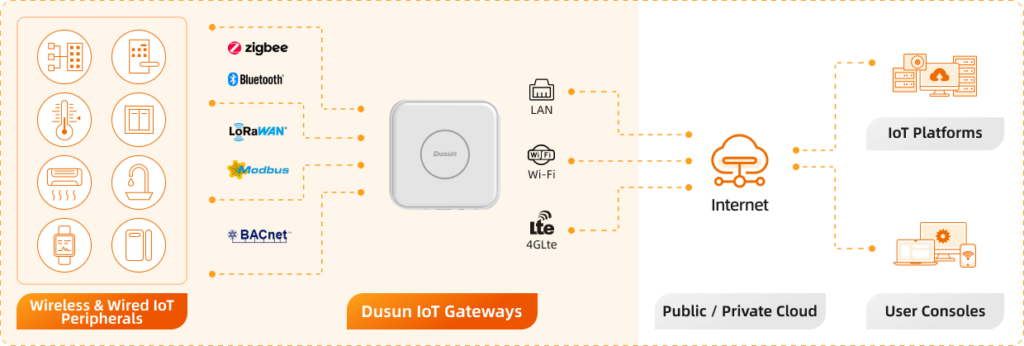
Dusun IoT’s Gateway is a tailored hardware solution specifically designed for enterprise IoT developers. By offering a mature and comprehensive programmable gateway hardware platform, partner’s can easily port or independently develop applications, or modify and conduct secondary development on the underlying firmware based on the open-source SDK. This significantly simplifies the complexities involved in the development of IoT gateways and solutions, reducing the time to market.
Popular Multi-Protocol IoT Gateways at Dusun IoT
-
 Rated 0 out of 5
Why Choose Dusun IoT Gateway Hardware
Flexible Programmability
Dusun IoT Gateway provide an extremely free, flexible and extensible hardware platform for developers to design and build smart, scalable and secure IoT solutions more efficiently.
Multiple-Protocols Support
Connect your devices in the best way for your use case, whether it’s cellular (LTE CAT M1, LTE CAT1), or 2.4 and 5 GHz Wi-Fi, or Zigbee, BLE, LoRaWAN, Modbus, CAN, etc.

Modular Design for Flexible Customization
All IoT gateway adopts modular design, which can be quickly tailored by excluding or adding components and features. Muti-protocols support for various applications (Zigbee, LoRaWAN, Wi-Fi, LTE, etc).

Tested and Full Certification
Dusun IoT gateways are fully tested and ready International certifications like BQB, FCC, IC, FAC, WPC, KC, NTC, RCM, and SRRC, etc.

Advanced Technology
Dusun incorporates the latest technologies so you have market-leading IoT gateway options for vairous industries.

Compatible & Simplified Integration
Dusun could also provide IoT Gateways with pre-installed software and preset IoT platforms for specific applications, makes it possible for smart connection and easy to use, simplified integration.

Dusun IoT Gateway Secondary Development Support
Dusun IoT provides comprehensive, rigorously tested development resources, ensuring high reliability and efficiency. Our expert FAE team offers personalized one-on-one support for partners addressing technical challenges during IoT gateway secondary development, accelerating time-to-market and gaining a competitive edge.
- Smart Terminal Connectivity Support
- Mastery of mainstream wired and wireless IoT protocols for quick smart terminal connections and debugging
- Standard object model design and Luci local management tool for visual and rapid development
- System/Application Porting
- Support Docker for application porting to expedite existing software/tools migration and debugging, cutting development costs and time
- Embedded algorithm model tools for easy local algorithm compilation and porting
- Software Development & Deployment Support
- Open-source SDKs for deeper customization, allowing custom firmware to fit specific hardware or functional optimization
- Open APIs for developing software functionalities like data collection and device control
- Cloud Platform Integration
- Support for standard MQTT/HTTP protocols for seamless third-party cloud integrations
- Pre-installed AWS and Azure plugins for zero-code integration with mainstream cloud platforms
Industries and Use Cases

IoT Gateways FAQs
What’s the difference between ARM SoM and MIPS SoM?
admin2025-05-17T16:44:30+00:00ARM SoM and MIPS SoM are both types of System on Module (SoM) that utilize different CPU architectures – ARM and MIPS, respectively. They are used in various applications due to their distinct features and benefits. Here’s a look at some typical aspects and applications of each:Typical ARM SoM:
- Features: ARM SoMs generally feature ARM Cortex processors, which could range from low-power Cortex-M series for microcontroller applications to high-performance Cortex-A series for more demanding tasks. They often include built-in memory (RAM and Flash), connectivity options (such as Wi-Fi and Bluetooth), and multiple I/O interfaces.
- Applications: Due to their power efficiency and performance, ARM SoMs are widely used in mobile devices, consumer electronics, industrial control systems, automotive applications, and IoT devices. They benefit from a large ecosystem and a broad range of available software and hardware support.
- Example: An ARM SoM might include a Quad-core ARM Cortex-A53 processor, Mali GPU, multiple USB interfaces, and support for various operating systems like Linux or Android.
Typical MIPS SoM:
- Features: MIPS SoMs often feature MIPS32 or MIPS64 processors, known for efficient pipeline and multithreading capabilities, which are advantageous in specific processing tasks. They may also include essential peripherals and interfaces similar to ARM SoMs.
- Applications: MIPS SoMs are commonly used in networking equipment (like routers and gateways), digital consumer electronics, and embedded systems that require robust data-handling capabilities. Their architecture can be beneficial in applications requiring efficient multitasking and high-throughput processing.
- Example: A MIPS SoM might incorporate MIPS64 processor cores, SDRAM, Ethernet connectivity, and several GPIOs designed for telecom equipment or smart home devices.
Both ARM and MIPS SoMs serve distinct market needs and are chosen based on factors such as power requirements, available development resources, target application performance, and ecosystem support. ARM’s wide adoption provides a versatile solution for diverse applications, while MIPS offers strong processing capabilities for specialized fields such as telecommunications and multimedia.
What are the common connection methods used to interface the SoM with the carrier board or other components.
admin2025-05-17T16:42:37+00:00In System on Module (SoM) design, several connection methods are commonly used to interface the SoM with the carrier board or other components. These connection methods include:- Board-to-Board Connectors:These connectors create a direct physical link between the SoM and the carrier board. They provide reliable high-density and high-speed connections, suitable for complex applications requiring extensive I/O options.
- Pin Headers: Pin headers are simpler connection methods where the pins of the SoM are directly inserted into corresponding sockets or soldered onto the carrier board. They are often used for prototyping and less complex designs.
- Edge Connectors: Edge connectors allow the SoM to slide into a slot on the carrier board. This method is common in applications where fast assembly and disassembly are necessary, offering ease of maintenance and replacement.
- Soldered Connections: For systems that require enhanced reliability and performance, the SoM can be directly soldered onto the carrier board. This provides a permanent and robust connection but limits flexibility in terms of module replacement.
What’s the difference between system on module and carrier board
admin2025-05-17T16:42:14+00:00The System on Module (SoM) and the carrier board together form a complete solution for embedded systems. The SoM handles core computing and processing functions, while the carrier board provides the necessary interfaces, power, and peripherals. This modular design allows developers to flexibly apply the SoM across different projects while customizing the mainboard to meet specific application needs. This combination not only accelerates development and time-to-market but also simplifies the design and upgrade process, offering high scalability and future-proofing for the system.- System on Module (SoM): A SoM is a compact, pre-packaged module that integrates a processor, memory, and essential system functions into one single unit. It is designed to handle the core processing needs of an embedded system with minimal engineering effort. The SoM serves as a building block that developers can use and reuse across different projects, providing a standardized framework for complex designs.
- Carrier Board: The carrier board, provides the necessary interfaces, connectors, and peripherals that allow the SoM to communicate with the external environment. It is designed to accommodate the SoM and provide power distribution, I/O connectivity, and any additional features the specific application requires.
Why use system on module
admin2025-05-17T16:41:39+00:00System on Module (SoM) is a compact and integrated board that combines a microprocessor, memory, power management, and other essential components into a single module. It serves as a building block for creating more complex systems, thereby simplifying the design and development process. By leveraging SoMs, companies can significantly reduce both the time and cost associated with bringing new products to market.- Faster Time-to-Market: SoMs can significantly reduce development time, allowing products to reach the market quicker. This can provide a crucial advantage in highly competitive industries.
- Reduced Development Risk: By using pre-tested and verified modules, the risk of encountering design flaws and unexpected issues is minimized compared to designing complex systems from scratch.
- Cost Reduction: SoMs can lower overall development costs by simplifying lifecycle management and reducing the bill of materials costs.
- Scalability and Flexibility: SoMs offer scalability and flexibility, permitting developers to adjust and upgrade designs according to needs. The modular design allows for easy integration of new technologies during the development process.
- Simplified Hardware and Software Development: SoMs provide a friendly design environment for both hardware and software developers, avoiding the challenge of building complex PCBs from scratch and allowing them to focus on product-specific functions.
- Easy Integration of Advanced Technologies: Developers can easily integrate AI models and other advanced technologies on SoMs to meet new application demands.
- Reduced Complexity: By integrating multiple system functions, SoMs reduce design complexity, allowing developers to deploy multiple applications using a single carrier board.
What is the difference between CoM and SoM?
admin2025-05-17T16:41:39+00:00Computer on Module (CoM), also known as a System on Module (SoM), is a single physical embedded module integrated into a system function that contains core components including SoC, memory blocks, power unit etc., which then be connected to a suitable carrier board via pins to create a complete embedded mianboard/development board.What Compoents does System on Module Contain?
admin2025-05-17T16:41:39+00:00Common System on module components include a CPU, RAM, flash memory, a power management unit, wired and wireless communication interfaces.- Microcontroller, at least one microprocessor or digital signal processor (DSP) core
- Memory blocks including a selection of ROM, RAM, EEPROM and/or flash memory
- Timing sources
- Industry standard communication interfaces: such as USB, FireWire, Ethernet, USART, SPI, I²C
- Peripherals including counter-timers, real-time timers and power-on reset generators
- Analog interfaces including analog-to-digital converters and digital-to-analog converters
- Voltage regulators and power management circuits