

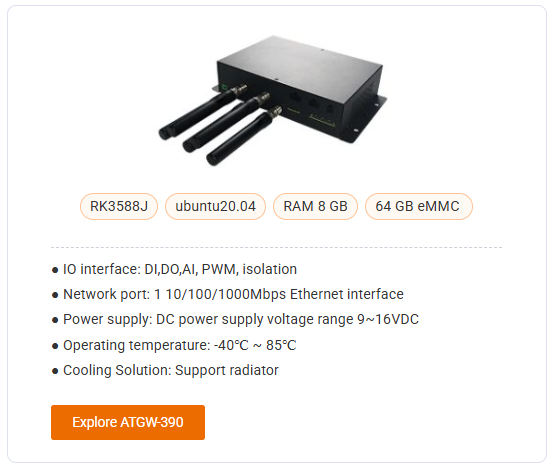
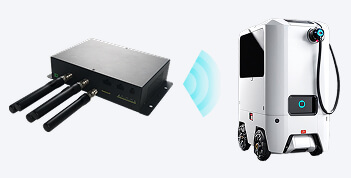
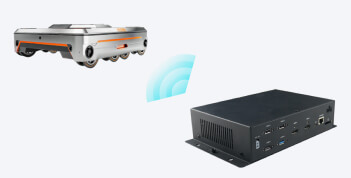
This robot controller solution is an ideal choice for medium and large-sized robots, suitable for charging robots, cleaning robots, AGVs/AMRs, etc. It integrates cutting-edge technologies, leveraging the ASL architecture and ROS/ROS1 to rapidly deploy the SLAM algorithm for precise environmental perception. The high-performance hardware, combined with advanced voice algorithms, enables sensitive sound pickup and smooth interaction. Its multi-core heterogeneous technology ensures rapid system response, effortlessly handling complex tasks and comprehensively facilitating the efficient operation of robots.

The VCU component of the robot controller is based on the RK3588J chip, integrating an octa-core CPU and a powerful NEON coprocessor. The built-in NPU can perform mixed operations with various integers and floating-point numbers, providing a computing power of up to 6 TOPS.

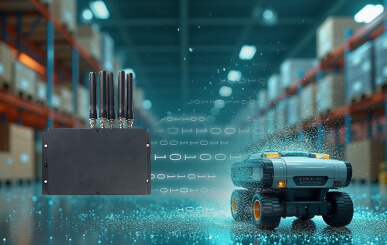
Convenient Secondary Development, Hassle – free Algorithm Transplantation, and Adaptability to Diverse Scenarios

Professional R&D Capability, High Quality and Quick Response
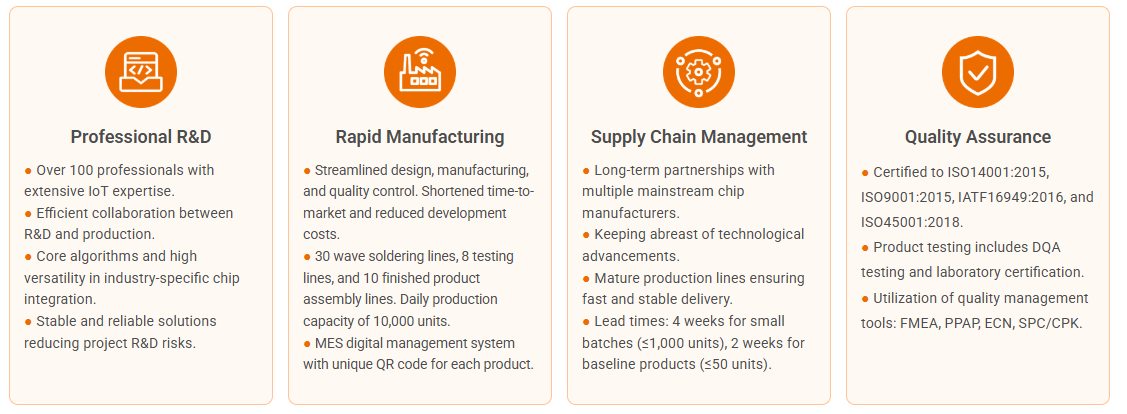
Professional R&D Capability, High Quality and Quick Response

Robot Controller FAQs
What are the core components of the Antek robot controller? How do they work together to achieve high-performance computing?
The core component of the Antek robot controller is based on the RK3588J chip. This chip integrates an octa-core CPU, a powerful NEON coprocessor, and a built-in NPU that can perform mixed operations with various integers and floating-point numbers. These components work in tandem. The CPU is responsible for handling regular computing tasks, the NEON coprocessor accelerates media and signal processing, and the NPU focuses on deep learning and edge computing. Together, they achieve a computing power of up to 6 TOPS, providing the device with strong processing performance.
How does the Antek robot controller perform in terms of EMC standard design?
The Antek robot controller performs excellently in EMC (Electromagnetic Compatibility) standard design. Our R&D team is proficient in international EMC standards. Every aspect, from circuit layout, shielding design to filtering treatment, has been meticulously refined. Through advanced simulation technology, electromagnetic interference issues are predicted and optimized in advance, ensuring that the controller can still operate stably in complex electromagnetic environments, such as industrial production workshops and intelligent warehousing and logistics centers, without signal interruptions, data errors, and other situations, thus guaranteeing the continuity and accuracy of robot operations.
Can the Antek robot controller be used for secondary development?
The Antek robot controller provides customers with an extremely convenient secondary development environment. We have opened up a wealth of API interfaces, accompanied by detailed development documents and sample codes. Whether customers have simple function expansion requirements or need to carry out complex system customization, they can easily get started. The professional technical support team is on standby at all times and can promptly answer the questions that customers encounter during the secondary development process, greatly shortening the development cycle, reducing development costs, and helping customers quickly transform their ideas into actual product functions.
What are the unique features of the structural design? How does this design enhance its durability and stability?
The Antek robot controller adopts an aluminum alloy structure. This material has good durability and heat dissipation performance. At the same time, the device is also equipped with a cooling system to ensure stable operating temperature during high-intensity computing. The sturdy metal shell and effective heat dissipation design jointly enhance the durability and stability of the controller, enabling it to work reliably in various environments.
How about its environmental adaptability? In which extreme conditions can the Antek robot control box work normally?
The Antek robot controller is designed according to industrial standards, with an operating temperature range of -40°C to 85°C. This means that it can work normally in extremely cold or hot environments. The sturdy metal shell further enhances its reliability in harsh conditions, making this controller an ideal choice for various industrial application scenarios.
Which multimedia output interfaces are supported? How do these interfaces of the Antek robot controller enhance the user experience?
The Antek robot controller supports a variety of video output interfaces, such as HDMI, LVDS, and USB DP, etc., and also supports dual-channel audio output. The design of these multimedia interfaces aims to enhance the user experience, enabling users to easily connect various audio and video devices through the master controller and enjoy a high-quality audio-visual experience.
What is the function of the rod-shaped antenna design of the robot controller? How does it affect the wireless performance of the device?
The rod-shaped antenna design of the Antek robot controller is aimed at optimizing wireless performance, ensuring that the device can maintain a stable wireless connection even in complex environments. The rod-shaped antenna has better directivity and gain performance, and can more effectively receive and transmit wireless signals, thereby improving the wireless communication stability and coverage of the robot controller.
How does the robot controller ensure reliability in harsh industrial environments (such as high temperature, high humidity, and strong electromagnetic interference)?
The Antek robot controller adopts a sturdy metal shell and an industrial standard design, with an operating temperature range of -40°C to 85°C, and can be used in harsh conditions. Its stable performance ensures reliable operation in various environments. In terms of hardware design, electronic components that are resistant to high temperature and moisture-proof, as well as a shell with good sealing and heat dissipation, are used to ensure normal operation in high-temperature and high-humidity environments. For strong electromagnetic interference, through shielding technology, a metal shielding cover is used to isolate external electromagnetic signals, and the internal circuit is reasonably wired to reduce electromagnetic coupling. In terms of software, anti-interference algorithms are added, and the sensor data is filtered to remove interference signals, ensuring that the controller can accurately receive and process signals in harsh environments and operate reliably.
How about its algorithm transplantation ability? Can it make the robot controller more intelligent?
In the face of customers’ diverse algorithm requirements, Antek demonstrates strong algorithm transplantation ability. Our technical team is proficient in a variety of mainstream algorithm languages and can quickly understand and adapt to various complex algorithms. Whether it is a visual recognition algorithm, a path planning algorithm, or other cutting-edge algorithms, they can all be accurately transplanted onto our robot controller. By optimizing the adaptation between the algorithm and hardware resources, the performance advantages of the controller are fully utilized, ensuring that the algorithm operates efficiently and stably in practice, providing a solid support for the robot to perform more intelligent and accurate operations.
How reliable is the device design on the controller? Is it shockproof?
In terms of the reliability design of the connectors, Antek has invested a great deal of effort. We select high-quality connector materials and conduct strict aging tests, plugging and unplugging life tests, and environmental adaptability tests. The unique structural design enhances the stability of the connectors, effectively resisting the impact of harsh environments such as vibration, shock, and humidity. Whether it is frequent device connection and disconnection or use in special scenarios such as outdoors, high temperature, and high humidity, the connectors can maintain good electrical connection performance, reducing the risk of system failures caused by connector failures and extending the overall service life of the robot controller.
What kind of certification services can be provided?
Antek has a professional certification team with strong certification capabilities. We are familiar with various global certification standards such as CE, FCC, ROHS, etc. From the product design stage, planning is carried out in accordance with the corresponding certification standards to ensure that the product meets the requirements in multiple aspects such as function, safety, and environmental protection. With rich certification experience and efficient communication and coordination capabilities, we can quickly promote the certification process, shorten the product launch cycle, help customers quickly obtain market access qualifications, and enhance the competitiveness of products in domestic and foreign markets.
